

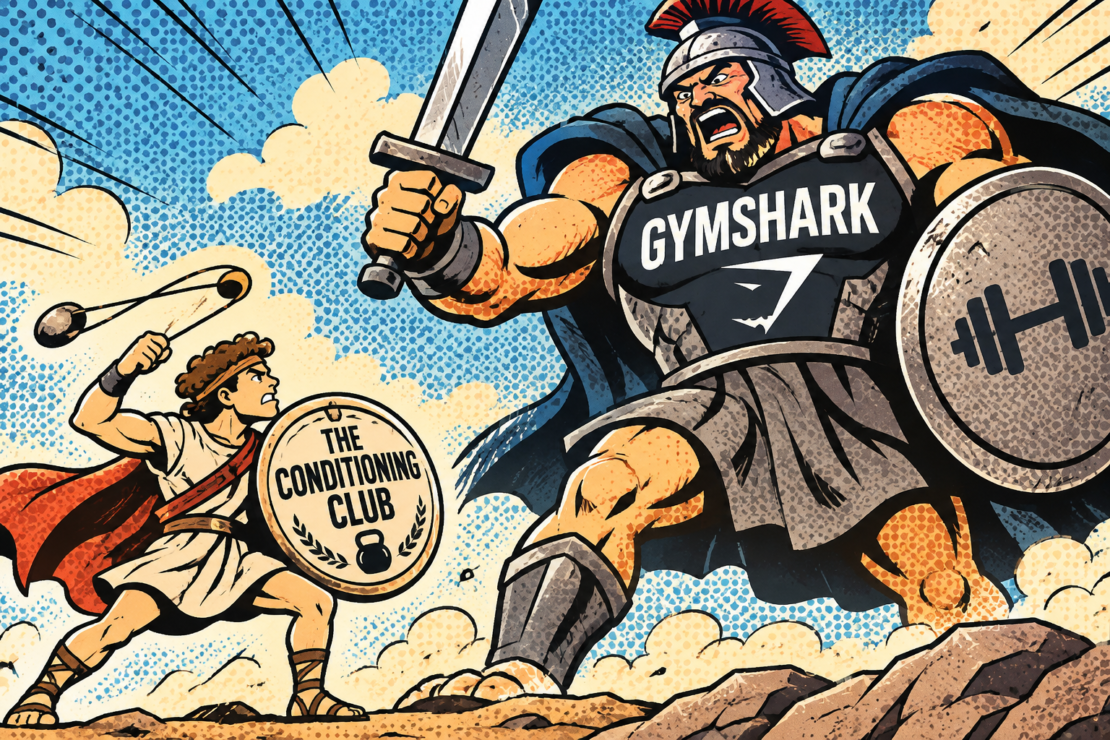
Running a gym is hard work. You need equipment, customers, trainers, motivation… and apparently, a very good lawyer.
At least, that’s what John Watson, owner of The Conditioning Club, an independent gym in Fairford, England,is discovering.
His small business is currently involved in a trademark dispute with Gymshark, the international sportswear giant. And no, they’re not arguing over who has the best six-pack.
They’re fighting over a name.
Welcome to the wonderful world of intellectual property, where two perfectly ordinary words can suddenly become extremely expensive.
How Did We Get Here?
Let’s go back to 2021. Watson registered “The Conditioning Club” as a trademark for gym and fitness services.The registration was granted in November, and life continued as normal.
Then, in March 2025, Gymshark applied to register “Conditioning Club” and “The Conditioning Club” for several categories, including clothing, retail and entertainment. The company also sells a clothing collection called Conditioning Club.
Same name. Different commercial activities. What could possibly go wrong?
Well, quite a lot, apparently.
Watson opposed Gymshark’s applications and later tried to extend his own trademark protection to clothing and retail.
Gymshark responded by opposing that extension and challenging the validity of his original trademark, arguing that “The Conditioning Club” is too descriptive to qualify for trademark protection.
So, we went from “Can we both use this name?” to “Should your trademark even exist?”
That escalated quickly.
And here’s where things become particularly uncomfortable. According to Watson, defending his position has already cost him close to £30,000. He’s even launched a crowdfunding campaign to help pay the legal bills.
That’s quite an expensive membership. And we’re pretty sure it doesn’t include personal training.
Of course, being smaller doesn’t automatically make Watson right, and being bigger doesn’t automatically make Gymshark the villain. Both businesses have interests to protect, and trademark law isn’t decided by whoever gets the most sympathy on social media.
So, Who’s Winning?
Nobody has been declared the winner.
According to the latest available reports, the dispute remains unresolved. Both parties have shown some willingness to reach an agreement, potentially allowing Gymshark to use the name for clothing and retail while The Conditioning Club retains its protection for fitness services.
In other words, they might eventually agree that there’s enough room in the world for two Conditioning Clubs.
Revolutionary concept, we know.
But no final agreement or ruling has been reported. For now, the lawyers are probably getting more exercise than anyone else.
And What Does This Have to Do With Licensing?
Quite a lot, actually.
Because protecting a brand isn’t just about its name. It’s about its logos, colours, designs, visual identity… and something that can be considerably less exciting but much more expensive: knowing exactly where and how you have the right to use it.
Think about it. A brand might have clear trademark protection for fitness services or apparel, yet lack the rights to extend into adjacent categories like accessories, footwear or branded experiences.
And suddenly, that brilliant brand extension strategy starts looking a little less brilliant.
Imagine spending months developing a fantastic licensed collection, approving every detail, getting the colours absolutely perfect and preparing the big launch.
Champagne ready. Marketing campaign approved. Everyone celebrating.
And then someone asks: “Are we actually cleared to use this trademark in that product category?”
Silence.
Someone quietly puts the champagne back in the fridge.
That’s why licensing isn’t simply about putting a famous logo on a product and hoping for the best. It’s about understanding trademark rights, territories, product categories and contractual restrictions, while making sure the brand’s identity is respected.
Because getting the logo right is important. But getting the logo right on a product you have no right to sell?Well, congratulations on your attention to detail.
And that’s what makes the Gymshark story particularly interesting.
Watson actually registered his trademark. He took steps to protect his business. Yet he’s still facing a costly legal battle with a company whose financial resources are considerably greater than his own.
Of course, even careful trademark planning cannot guarantee that disputes will never happen. But knowing what you can protect, where you can protect it and what rights you can actually license can help avoid some very unpleasant surprises.
Because building a recognizable brand takes years. Protecting it takes planning. And defending it against a much bigger company?
Apparently, that can take £30,000 and a crowdfunding campaign.
So, isn’t it worth knowing exactly what you’re entitled to protect and license before finding out how much a trademark dispute can cost?


