

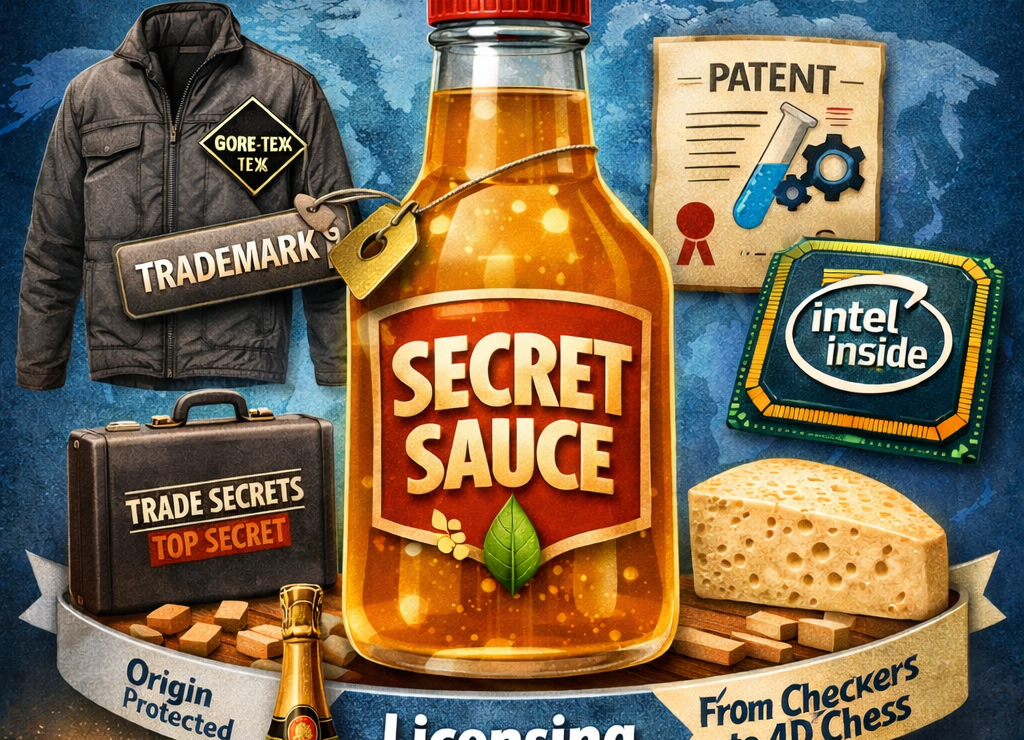
Ever wondered why you’re paying $50 extra for a jacket just because it has a tiny GORE-TEX® tag, or why your computer feels smarter because of an Intel Inside sticker?
Welcome to the high-stakes world of ingredient branding. It’s the ultimate Inception of marketing: a brand, inside a brand, wrapped in a legal burrito of Intellectual Property (IP).
What Exactly Is An Ingredient Brand?
In the old days, an ingredient was just… an ingredient. Now, if it has a cool name and a logo, it’s a quality signal. Think of it as the difference between some generic fiber and KERNZA® perennial grain.
To pull this off, companies build a Legal Voltron consisting of:
• Trademarks: You can’t trademark wheat, but you can trademark a funky name and logo that implies your wheat was grown by monks in a remote alpine valley with perfect moonlight.
• Patents: The how-to. This protects the science—like a specific pH level that keeps your probiotic drink from becoming a science experiment.
• Trade Secrets: The Col. Sanders approach. Keep the exact recipe locked in a vault and use NDAs to keep everyone quiet.
From Champagne To Chicory: Origin Is Everything
Then we have Origin Brands. This is the “You can’t call it Champagne unless it’s from France, otherwise it’s just Sparkling Sadness” rule.
In the EU, these are Geographical Indications (GIs). They are collective rights. It’s like a neighborhood association, but instead of complaining about your lawn height, they ensure nobody calls their cheese Parmigiano Reggiano unless it actually smelled a cow in Parma.
The Licensing Dance (or: How To Get Your Logo On Someone Else’s Box)
This is where the money moves. A branded ingredient owner licenses their IP to a manufacturer.
• The Deal: You can use my shiny logo on your box, but ONLY if you use 10% of my magic powder and let me audit your factory whenever I want.
• The Win: The manufacturer gets to charge a premium, and the ingredient owner scales their business without ever having to bake a single cookie.
The real genius of ingredient branding is that it flips the usual marketing equation on its head. Instead of every manufacturer having to build trust from scratch, the ingredient brand builds that trust once — and then licenses it everywhere.
Why Bother? (The Humorously High Cost Of Fame)
Is it worth it?
• The Pro: You get Borrowed Equity. You’re the cool new kid sitting at the popular table. Research shows people might pay 9% more just because your snack has a branded protein badge.
• The Con: It’s expensive. You have to spend millions making consumers care about an ingredient they can’t even see. It’s like trying to make oxygen a premium brand.
What’s Trending In 2026?
We’re moving toward Science on the Pack. We’re seeing branded fibers designed for the new wave of metabolic-health products.
The Takeaway
If you’re selling a commodity, you’re playing checkers.
If you’re licensing a branded ingredient, you’re playing 4D chess — with marketing, science, and lawyers all on the same team.


